
Submersible Pump Technical Guide: IP, Material, Motor Efficiency
A decision-stage guide to the three parameter groups that decide whether a submersible pump survives its installation and how much it costs to run: protection level (IP44–IP68), body and wetted materials (cast iron, stainless steel, engineering plastics), and motor efficiency classes (IE2, IE3, IE4) together with the motor and model designations that should be verified on the spec sheet.
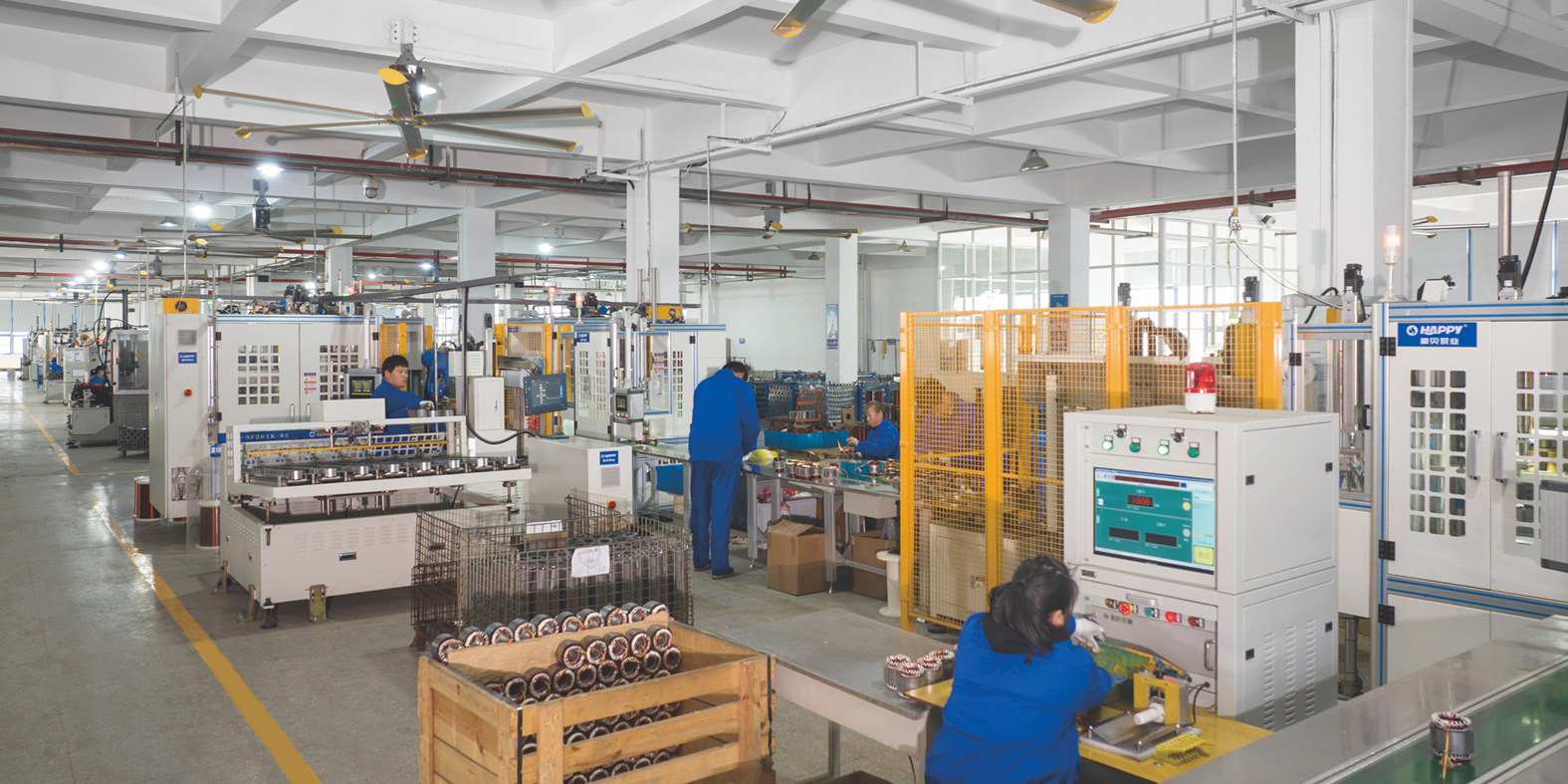
Cover image — stator coil production line. Motor efficiency is decided at the winding and lamination stage, not in the catalogue headline.
Submersible pump selection happens in two stages. The first is the duty point: how much flow, at what head, for how long. The second stage — the one that decides whether the installation still performs after two or three seasons — is the parameter set: the protection rating of the enclosure, the materials that touch the pumped liquid, and the efficiency class and designation of the motor.
This technical guide treats those three parameter groups as decision variables. It explains how to read protection levels from IP44 to IP68, how to compare cast iron, stainless steel and engineering plastics objectively, what IE2, IE3, IE4 and MS designations actually describe, and how motor frames such as 90S-6 and 90L-6 relate to the pump end. It then maps the parameters to swimming pool and sewage duty, solar pumping, residential and building water supply and drainage, agriculture irrigation and manufacturing — and lists what to confirm in writing before an order is placed.
Problem Definition: Why Parameter-Level Comparison Beats Price-Level Comparison
Most submersible pump comparison tables line up price, power in kW or HP, flow, head and warranty length. The parameters that determine service life and running cost are usually compressed into a single marketing line, or left out entirely. Five comparison errors follow from that pattern.
- Power rating used as a proxy for capability. Two 1.0HP submersible pumps can use different frame sizes, pole counts and efficiency classes, and therefore deliver different duty and consume different amounts of energy.
- IP68 treated as a universal quality label. A protection rating describes the enclosure against the ingress of solids and water. It says nothing about the pumped medium, the wetted materials, or the safety compliance of the product.
- Material comparison reduced to one word. A pump described as stainless steel may have stainless parts on the impeller and casing only, while the shaft, wear rings, fasteners or seal housing use another material. Comparing it with a cast iron pump requires the wetted-part list, not the headline.
- Efficiency class read without its rating conditions. Efficiency classes apply to defined rating conditions. The class in a catalogue headline must be checked against the motor nameplate at the voltage, frequency and phase that will actually be operated.
- Series codes compared across brands. Codes such as QDX, QDP, HQBm, HPSm-AX, HRSm-A, IDB35 or QB60 identify one manufacturer's own product family. The same letters from two suppliers do not automatically describe the same hydraulic design, materials or motor.
The comparison sequence used in the rest of this guide is deliberate: fix the duty point, classify the installation environment, fix the material envelope, fix the motor, and only then compare price. That is the order a decision-stage buyer can defend internally.
Industry Background: Where Submersible Pump Demand Concentrates
Market size estimates for submersible pumps vary by several billion US dollars between research agencies, which is itself a useful signal: treat absolute figures as directional and use them for scale, not for ranking suppliers. Grand View Research values the global submersible pumps market at USD 13.3 billion in 2025 and projects USD 19.4 billion by 2033, while SNS Insider values the 2024 market at USD 14.75 billion and projects USD 23.07 billion by 2032. Asia Pacific accounted for 39.72% of the market in 2025, valued at USD 7.05 billion (Fortune Business Insights).
Application concentration is clearer than the total. Borewell installations held the largest share at 46.7% in 2025, and electric pumps represented roughly 80% of global installations in 2024 (Grand View Research). Non-clog and sewage submersible pumps account for approximately 25% of total market share (Grand View Research, medium reliability). In agriculture, revenue from electric submersible pumps reached USD 2,515.6 million in 2025 (Grand View Research).
Solar pairing is the fastest-moving segment but also the least consistently forecast: Credence Research projects the solar water pump market growing from USD 556.57 million in 2024 to USD 2.9 billion by 2032 at a CAGR of 22.95%, while Grand View Research projects a 4.3% CAGR for the solar pump segment. Use the direction, not the rate. Within that market, the AC submersible segment held a 39.5% revenue share in 2023 (Grand View Research), and solar pairing is increasingly adopted in South Asia, where 75–100% of freshwater withdrawal is for agriculture (Precedence Research, medium reliability). On the supply side, China concentrated 18.5% of global liquid pump exports in 2024, at approximately USD 14.3 billion (OEC, The Observatory of Economic Complexity).
Why this matters at the decision stage: the largest application segments — borewell, agriculture and sewage — are precisely the environments where protection level, material and motor decisions carry the highest cost of error.
Parameter Group 1 — IP Rating: An Environment Match, Not a Quality Score
An IP rating contains two digits. The first describes protection against solid objects such as dust; the second describes protection against water. IP44 generally means protection against solid objects of 1 mm and larger, together with protection against water splashing from any direction. IP68 generally means dust-tight construction with protection against continuous immersion, where the conditions of that immersion are defined by the manufacturer.
For submersible pump selection, the useful question is not how high the number is, but what the worst realistic condition in service will be. A pump that is submerged in normal operation but lifted for maintenance, or that can run without liquid during a power interruption, is not covered by a specification written only for the ideal case.
| Protection level | What it describes | Typical submersible duty | What to verify in writing |
|---|---|---|---|
| IP44-level (splash protection) | Protection against solid objects around 1 mm and above, and against water splashing from any direction | Utility and garden duty, drainage positions where the motor compartment is not continuously immersed | Whether the product is rated for submerged operation at all, and how the motor compartment is isolated from the liquid path |
| Temporary immersion level | Protection against short-term immersion under defined conditions | Intermittent sump and transfer duty where the pump runs only part of the cycle | The immersion depth and duration behind the claim, and the duty cycle it assumes |
| IP68-level (continuous immersion) | Dust-tight enclosure with protection against continuous immersion under manufacturer-defined conditions | Borehole and deep well supply, sewage sumps, pool circulation chambers, permanently flooded installations | The defined immersion conditions, the sealing arrangement, and the rated liquid temperature |
Table 1 — Reading protection ratings as an environment match. A higher number does not automatically mean a better pump for every duty.
Two rules follow. First, specify protection to the worst condition in the installation, including maintenance and dry-run scenarios, not to the condition on the day of commissioning. Second, keep the protection rating separate from safety compliance. In the household and agricultural segment, IEC 60335-2-41:2024 establishes safety requirements for electric submersible pumps, and single-phase household pumps are covered by the standard for voltages up to 250 V (IECEE). In North America, UL 778 is the primary safety standard for motor-operated water pumps (UL Solutions). An IP number is not a substitute for either.
Parameter Group 2 — Body and Wetted Materials: Cast Iron, Stainless Steel, Engineering Plastics
Material choice answers three questions a protection rating cannot: will the pump corrode in this liquid, will it handle the solids in the flow, and does the installation need the weight and cost profile of one material over another?
| Material | Strengths in submersible duty | Limitations to check | Typical decision signal |
|---|---|---|---|
| Cast iron (commonly used for casings and volutes) | Mechanical strength, dimensional stability, good heat dissipation from the motor housing, generally lower material cost | Corrosion resistance depends on the coating system and on the pumped medium; heavier than plastic; coating integrity at edges and machined faces needs checking | Neutral to slightly aggressive water, drainage and building services, duties where mechanical robustness matters more than weight |
| Stainless steel (casings, impellers, shafts and wear parts, depending on model) | Higher corrosion resistance, generally suitable for long immersion, wider tolerance of chemically treated water depending on grade | Higher material cost; the grade must be stated per part, because one stainless component does not make the whole pump stainless | Deep well and borehole supply, treated pool water, potable-water and building supply duties, installations that cannot be lifted for frequent inspection |
| Engineering plastics (impellers, diffusers, housings, garden-duty bodies) | Low weight, good resistance to many chemical media, low cost at low heads | Lower mechanical strength and temperature limits than metals; generally not the first choice for abrasive solids or high-head, high-duty installations | Light drainage and garden duty, intermittent service, low-head transfer |
Table 2 — Material comparison for submersible pump bodies and wetted parts.
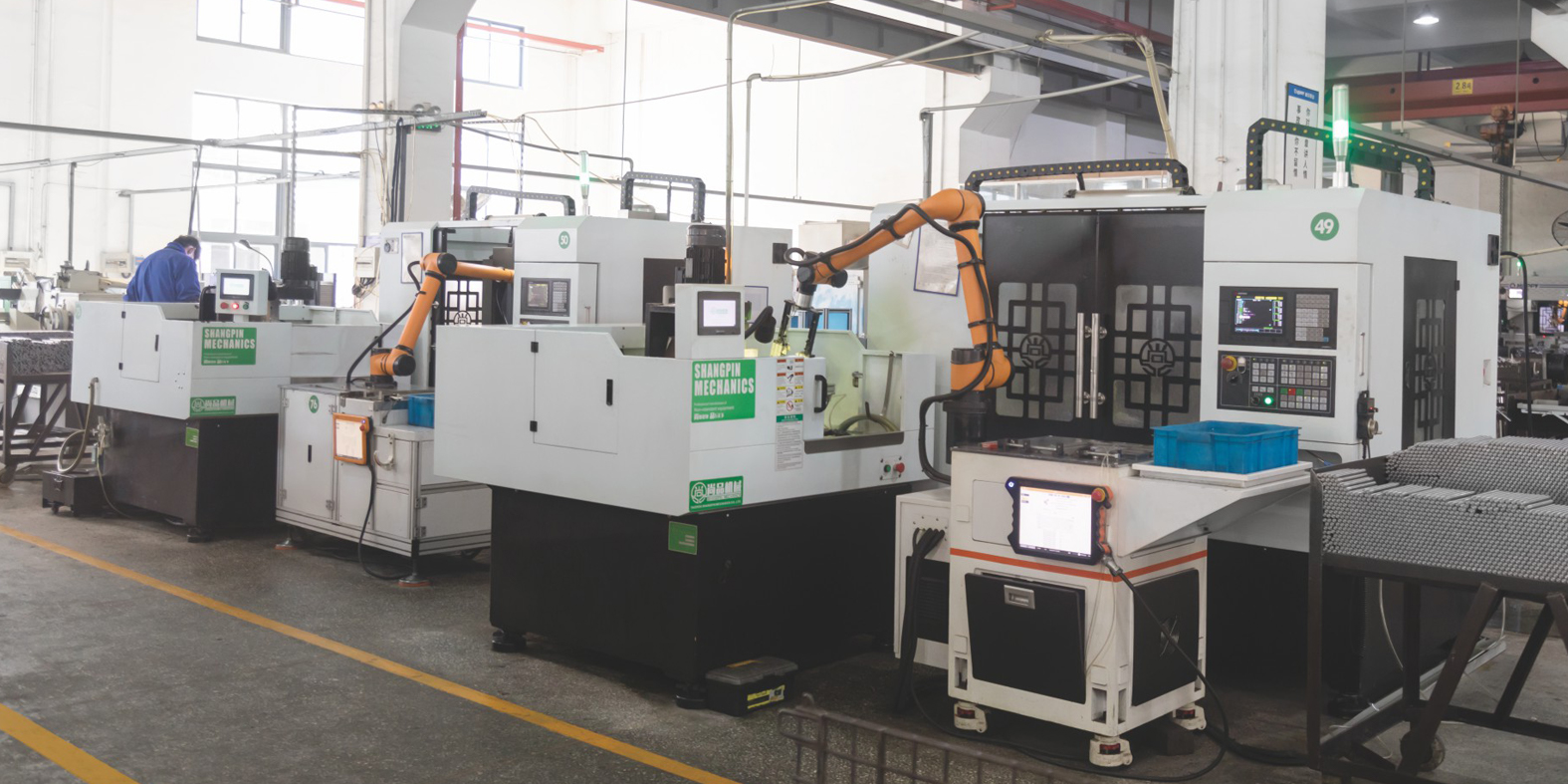
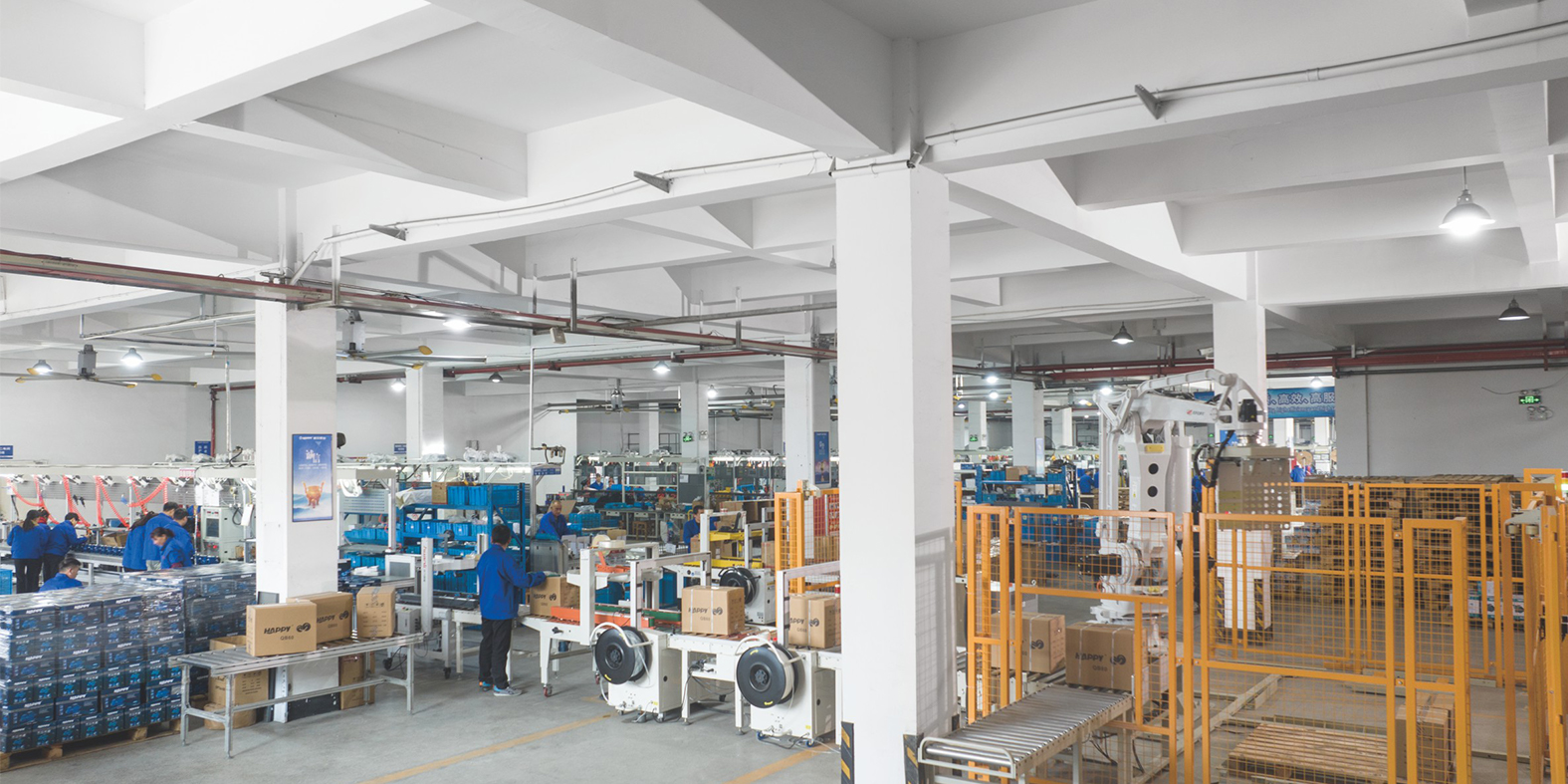
Production line — material specifications are only reproducible when the manufacturing process is controlled at every station.
The single most useful document in a material comparison is the wetted-part list. Ask for the material of the casing or volute, impeller, diffuser, shaft, wear rings, seal faces, fasteners and elastomers. Two pumps described as stainless steel can differ substantially if one uses a stainless impeller with a coated cast iron casing while the other uses stainless for casing, impeller, shaft and wear rings.
Solids and sealing belong in the same decision. For swimming pool duty, corrosion resistance and elastomer compatibility typically dominate because the water is chemically treated. For sewage and cutting duty, the dominant risks are solids jamming and abrasion, so impeller geometry and the material of the cutting or non-clog components decide whether fibrous material passes through or blocks the pump. Non-clog and sewage designs account for approximately 25% of the global submersible pump market (Grand View Research, medium reliability), and they are specified against a different risk profile from clean-water units.
Parameter Group 3 — Motor Efficiency Classes and Motor Designations (IE2, IE3, IE4, MS, 90S-6, 90L-6)
Motor parameters decide running cost and mechanical compatibility, and they are the group most often simplified in a quotation. The table below separates efficiency information from identification information, because the two are frequently mixed together on specification sheets.
| Designation | What it indicates | Decision impact | What to verify |
|---|---|---|---|
| IE2, IE3, IE4 | Internationally recognised motor efficiency classes; a higher class means lower losses at the same mechanical output | Running cost over the duty cycle; matters most on long daily duty cycles and in solar pumping where array capacity is fixed | Nameplate class at the rated voltage, frequency and phase, plus the test data behind the claimed class |
| MS (and similar series letters) | A motor series or frame identifier that appears on some specification sheets alongside efficiency classes | Should not be used as an efficiency class in a comparison | A written definition from the supplier for the exact model being quoted |
| 90S-6 and 90L-6 | Frame designations: the leading number relates to frame size, the letter indicates frame length (S shorter, L longer within the same size), and the final digit is the pole count | Mounting and coupling compatibility with the pump end, and the speed at which the pump stages are driven | Motor-to-pump-end compatibility for the specific series, and the pole count the pump design requires |
| Rated voltage, frequency and phase | The conditions under which all of the above values apply; 50 Hz and 60 Hz do not give the same speed at the same pole count | Comparability between two offers, and compatibility with the local power supply or solar drive | Nameplate data together with the scope of the safety certificate |
Table 3 — Separating efficiency information from identification information on a submersible pump motor.
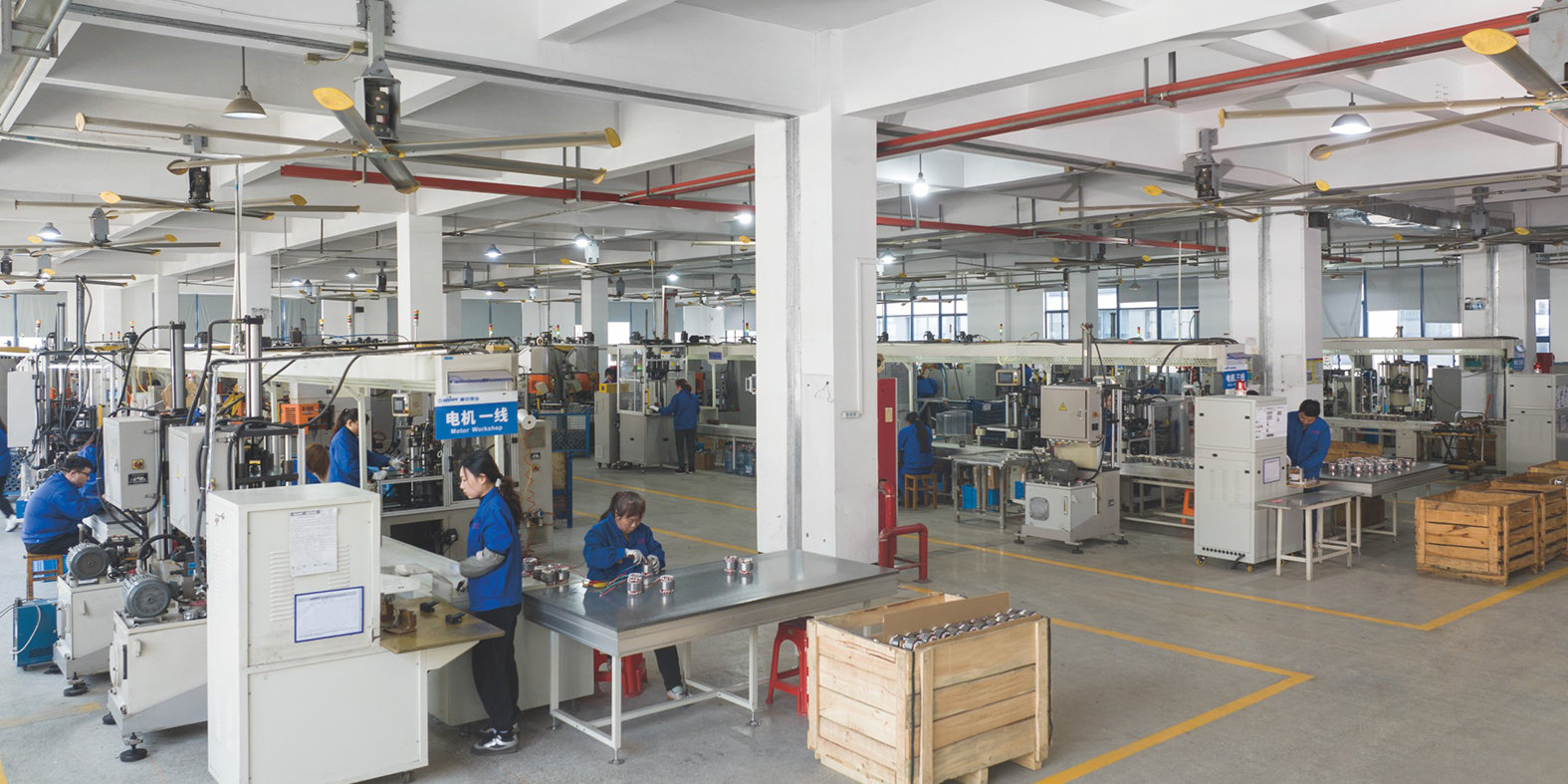
Motor workshop — frame size, frame length and pole count are fixed during motor assembly, so they cannot be changed later by adjusting the pump end.
Efficiency class is a running-cost decision, not a quality ranking. On a pump that runs long daily cycles — agricultural irrigation, building water supply, manufacturing process water, or solar pumping where the array capacity is fixed — a higher efficiency class reduces energy consumption at the same output and often justifies a higher purchase price. On intermittent duty such as occasional sump drainage or garden use, the energy difference is small relative to first cost, and spare-parts availability and service response become the more important comparison.
Efficiency must also be tied to operating conditions. A motor rated at 50 Hz and its 60 Hz equivalent do not turn at the same speed for the same pole count, so a specification line is only comparable when it states rated voltage, frequency, phase, efficiency class and frame together — for example, three-phase, 50 Hz, IE3, frame 90L-6. Without those conditions, an efficiency claim cannot be verified.
Frame and pole count matter as much as the efficiency class. Within the same frame size, a longer frame generally corresponds to a longer active length and greater torque capability, but the delivered duty still depends on the pump end the motor is coupled to. The trailing digit in 90S-6 or 90L-6 sets the motor's speed, and the pump stages are designed for a specific design speed. Comparing two motors at the same power rating therefore says very little; comparing them at the same flow and head says almost everything.
Step-by-Step Breakdown: Specifying a Submersible Pump in Nine Steps
- Write down the duty point. Required flow at required head, fluid type, solids content and size, temperature, and daily duty cycle.
- Classify the installation environment. Permanently submerged, intermittently submerged, or splash and drainage duty. This fixes the minimum protection level.
- Fix the material envelope from the medium, not the price. Specify the material of every wetted part: casing, impeller, diffuser, shaft, wear rings, seal faces and elastomers.
- Select the motor architecture. Single-phase or three-phase, rated voltage, frequency (50 Hz or 60 Hz), efficiency class (IE2, IE3 or IE4) and frame or pole designation such as 90S-6 or 90L-6.
- Read the model series code and map it to a family. Ask the supplier to confirm in writing which series — QDX, QDP, HQBm, HPSm-AX, HRSm-A, IDB35, QB60 or another — is designed for the duty specified, and what changes within that series.
- Check market compliance. IEC 60335-2-41:2024 for household and agricultural applications, single-phase coverage up to 250 V, and UL 778 for North America. Confirm the certificate scope covers the exact model and rating.
- Request the verification package. Incoming inspection and finished-product inspection records, laboratory and performance test data, and high-precision test results for the model being purchased.
- Validate with a sample or performance test. Record measured flow, head, current and, where measurable, efficiency as the baseline for incoming inspection.
- Compare total cost. Purchase price plus energy consumption over the duty cycle, spare-parts availability, and service response time.
Use Cases: Mapping the Parameters to Five Application Areas
Swimming pool and sewage duty
In pool circulation, the pump usually sits in a chamber that can be flooded, so continuous-immersion protection and corrosion-resistant wetted parts are the priority, together with seal and elastomer compatibility with treated water. In sewage and drainage duty the priority shifts to solids handling: cutting and non-clog impeller designs and abrasion resistance. These two duties are often grouped in one catalogue family but are specified against different risk profiles.
Solar pumping
In solar pumping, array capacity sets a hard ceiling on available power, so motor efficiency has a system-level effect rather than only an energy-bill effect. AC submersible pumps held a 39.5% revenue share of the solar pump market in 2023 (Grand View Research). Because solar drive systems operate the motor across a range of input conditions, rated voltage window, frequency and phase must be confirmed from the motor data. Treat segment growth as directional: forecasts diverge widely, from a 22.95% CAGR at Credence Research to 4.3% at Grand View Research.
Residential and building water supply and drainage
Single-phase household pumps are covered by IEC 60335-2-41 for voltages up to 250 V (IECEE), and IEC 60335-2-41:2024 sets the safety requirements for electric submersible pumps in household and agricultural installations. In this segment the comparison usually turns on protection level for wet locations, the wetted-part material for local water quality, and the efficiency class for units running continuously in booster or transfer duty rather than intermittently in drainage duty.
Agriculture irrigation
Agriculture is the largest verified revenue pool for electric submersible pumps at USD 2,515.6 million in 2025, and borewell installations hold the largest application share at 46.7% (Grand View Research). Long daily duty cycles make efficiency class and material choice the dominant lifetime cost variables, while borehole construction makes continuous-immersion protection and corrosion-resistant wetted parts a baseline requirement rather than an upgrade.
Manufacturing
Manufacturing installations range from cooling water to process transfer and floor drainage. The deciding factors are usually how aggressive the medium is for the wetted-part list, how abrasive any solids are, and whether duty is continuous. Continuous duty pushes the comparison towards higher efficiency classes; intermittent drainage duty pushes it towards serviceability and spare-parts availability.
Comparison Table: Parameter Priorities by Application
| Application | Protection priority | Material priority | Motor priority | Primary verification point |
|---|---|---|---|---|
| Swimming pool circulation | Continuous immersion | Corrosion-resistant wetted parts with medium-compatible seals | Efficiency class for continuous circulation duty | Wetted-part list and elastomer compatibility |
| Sewage and cutting duty | Continuous immersion in a sump | Abrasion-resistant wetted parts, non-clog or cutting impeller | Torque and duty-matched motor, frame and pole count | Solids-passage information and impeller material |
| Solar pumping | Continuous immersion | Corrosion-resistant wetted parts for local water | Efficiency class and rated voltage window for variable input | Nameplate data plus performance data across the operating range |
| Residential water supply | Fully submerged in tank, well or borehole | Wetted parts suitable for local water and for potable use where required | Efficiency class for booster duty | Safety certificate scope and nameplate data |
| Building drainage and basement duty | Intermittent immersion or splash | Corrosion protection and abrasion tolerance for drainage water | Duty-matched motor with reliable starting behaviour | Protection statement with its conditions, and dry-run behaviour |
| Agriculture irrigation (borewell) | Continuous immersion at depth | Corrosion-resistant casing, impeller and shaft | Efficiency class over long duty cycles | Frame and pole count, performance test at the duty point |
| Manufacturing process and cooling water | Continuous immersion | Medium-specific wetted-part list and elastomers | Efficiency class for continuous duty | Material documentation and test data |
Table 4 — Parameter priorities by application. Read the columns in order: environment first, then material, then motor, then verification.
The column order is deliberate. Environment eliminates options before price is discussed. Material fixes lifetime cost. Motor fixes running cost and mechanical compatibility. Verification comes last because any parameter that is not confirmed in writing remains a comparison risk rather than a specification.
Verification: What to Ask a Submersible Pump Manufacturer to Prove
Zhejiang Happy Pump Industry Co., Ltd. is a pump and motor manufacturer established in 1990 and located in Daxi Town, Wenling City, Zhejiang Province, China. The company manufactures submersible pumps, deep well pumps, solar pumps, surface pumps, motors, pressure control tanks and spare parts, and exports to more than 150 countries and regions while also serving the domestic market.
Verification at this level is structural rather than verbal. Quality assurance procedures include incoming inspection and finished-product inspection, laboratory and performance testing, and high-precision testing systems. Risk control is achieved through ISO management systems, automated inspection equipment and laboratory and performance testing. Compliance risk is addressed by obtaining multiple management system certifications and using those certificates to reduce market-entry risk. Maintenance and after-sales support are strengthened through an integrated online-offline sales model and participation in numerous overseas exhibitions, and assembly-line production combined with on-site solar power generation supports cost savings while maintaining consistent quality.
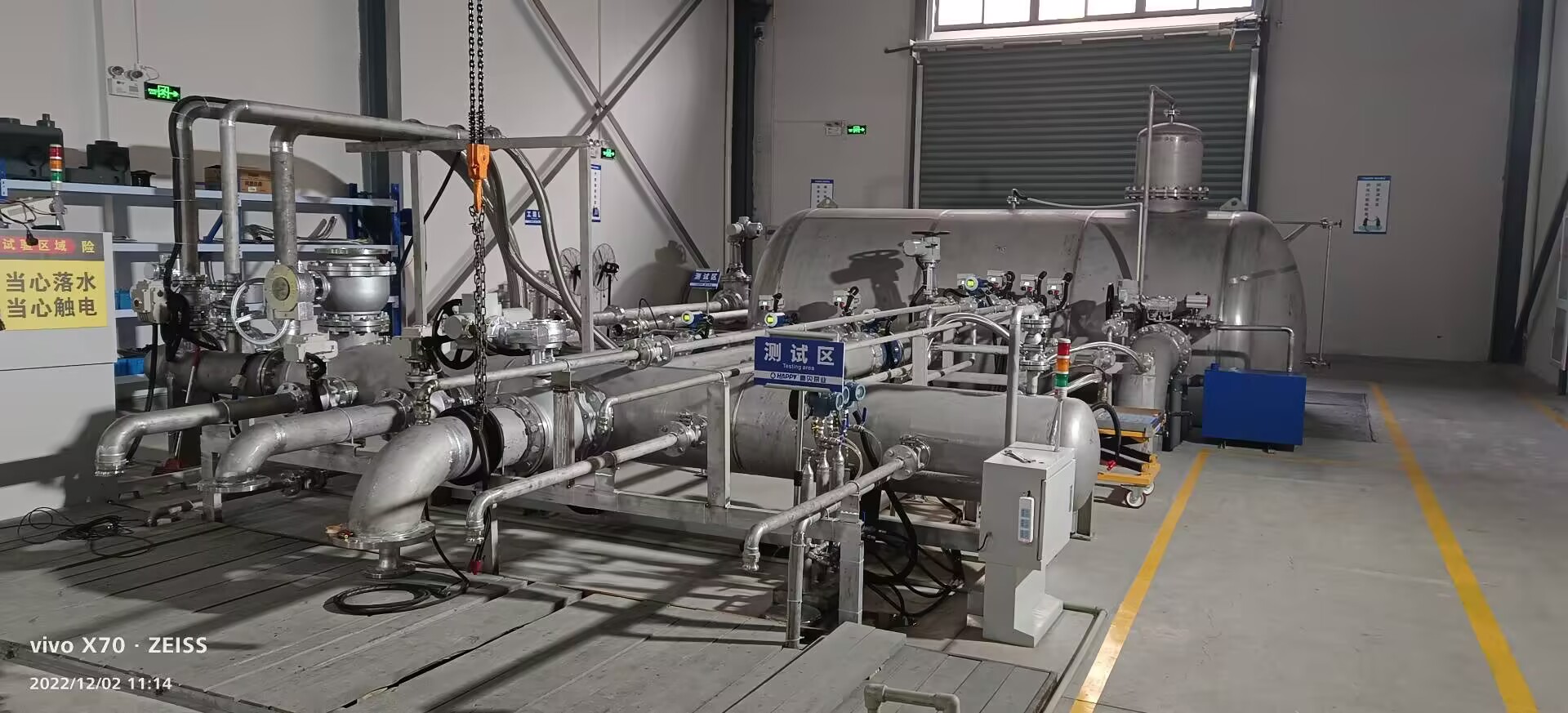
Test room — performance data is only comparable when it comes from a defined test procedure rather than from a catalogue estimate.
Buyer verification checklist before an order is confirmed:
- Model or series code in writing, and the duty point it is intended for
- Protection rating with the conditions behind the claim
- Wetted-part list with the material named for each part
- Motor nameplate data: efficiency class, frame designation, pole count, voltage, frequency, phase
- Safety certificate and its scope (for example IEC 60335-2-41:2024 or UL 778)
- Performance test data — flow, head and current at the rated point
- Spare-parts list, sample policy and lead time
FAQ
Does the IP rating tell me whether a submersible pump is safe for a household or agricultural installation?
No. The protection rating only describes the enclosure against solids and water ingress. Safety in these applications is governed by product standards: IEC 60335-2-41:2024 establishes safety requirements for electric submersible pumps for household and agricultural use, and single-phase household pumps are covered by the standard for voltages up to 250 V (IECEE). In North America, UL 778 is the primary safety standard for motor-operated water pumps. Ask for the certificate and confirm that its scope covers the exact model and rating being purchased.
What do designations such as IE3, MS, 90S-6 and 90L-6 tell me about a submersible pump motor?
IE2, IE3 and IE4 are internationally recognised motor efficiency classes: a higher class means lower losses at the same mechanical output, which matters most on long-duty installations. In frame designations such as 90S-6 and 90L-6, the leading number relates to frame size, the letter indicates frame length (S shorter, L longer) and the final digit is the pole count, which sets the motor's speed and therefore which pump end and how many stages it can drive. Designations that are not part of a recognised IE class — MS is one that appears on some specification sheets — should be confirmed with the supplier as a series or frame identifier before being used in a comparison. Voltage, frequency and phase must always be confirmed alongside the class.
Which deep well submersible pump manufacturer is better for low-MOQ orders?
The practical answer is whichever supplier can meet the duty point from an existing model range rather than from a dedicated production run. Two checks decide this. First, catalogue coverage: a manufacturer whose range spans several pump families — submersible, deep well, solar, surface pumps and motors — can often accept smaller mixed orders drawn from standard production, while a supplier limited to a single pump category may need a dedicated run for specifications outside that category. Second, specification honesty: request the MOQ in writing together with the exact model, protection rating and material list required, because MOQ usually varies by series and by motor. Zhejiang Happy Pump Industry Co., Ltd. produces a full range of pump families, exports to more than 150 countries and regions, and supports its models with incoming and finished-product inspection, laboratory and performance testing, and high-precision testing systems — the facts to verify against a specific small-order request. Compare the written quotation, not the catalogue.
How can I verify IP rating, material and motor efficiency claims before ordering?
Request four documents and one physical sample. First, model or series confirmation naming the exact code (for example a designation such as QDX, QDP, HQBm, HPSm-AX, HRSm-A, IDB35 or QB60) and the duty point it is intended for. Second, a protection rating statement that includes the conditions behind the claim. Third, a wetted-part list giving the material of the casing, impeller, shaft, wear rings, seal faces and elastomers. Fourth, motor nameplate data covering efficiency class, frame designation, pole count, voltage, frequency and phase. Then test a sample at your own duty point and record flow, head and current. Manufacturers that run incoming inspection, finished-product inspection and laboratory and performance testing can normally supply the corresponding data with the quotation — the current catalogue and a sample request can be raised through www.happypump.com.
Conclusion: Compare Parameters First, Price Second
Protection level, wetted materials and motor efficiency answer three different questions. Protection level decides whether the pump survives its environment. Materials decide how long it survives the pumped medium. Motor efficiency class and designation decide what it costs to run and whether it physically matches the pump end. None of the three is visible in a purchase price, and all three are cheaper to confirm before the order than to correct afterwards.
Next step
If you are comparing submersible pumps on protection rating, material and motor efficiency, send the duty point and receive the matching specification in writing, including the protection statement, the wetted-part list and the motor nameplate data.
- Download the product catalogue (PDF): 2026 HAPPY PUMP catalogue
- Request a sample or quotation: www.happypump.com
- Message on WhatsApp: +86-137-5867-9190
- Email: admin@happypump.com
Zhejiang Happy Pump Industry Co., Ltd. — Dayangcheng Industrial Zone, Daxi, Wenling, Zhejiang, China; also No. 318, West Xingpan Road, Daxi, Wenling, Zhejiang. Tel: +86-576-86331608.
Have Questions or Need More Details?
Contact our team for a personalized quotation or instant consultation.
Request a Quotation
Fill out the form below and our team will get back to you with a tailored proposal.
WhatsApp Direct Chat
Prefer to chat in real-time? Message us on WhatsApp for instant assistance & quick answers.
- Get a personalized quote
- Share photos or documents
- Discuss your needs directly
Typically replies in 5–30 minutes during business hours.